 Privalexx Ukraine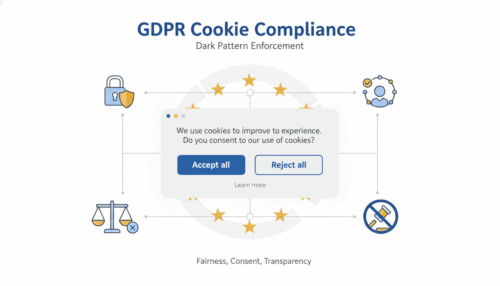
EU data protection authorities (DPAs) are increasing enforcement against unlawful tracking, non‑compliant cookie banners, and manipulative interface designs—often called “dark patterns.” For Ukrainian businesses serving EU users, the message is clear: consent must be valid under GDPR and ePrivacy rules, and user choices must be respected across web and mobile.
Why this matters now
Regulators are coordinating sweeps and issuing decisions that demand higher standards for consent, transparency, and user experience. Pre‑ticked boxes, obscured “Reject all” options, and tracking before consent are repeatedly deemed unlawful.
- Enforcement focus: Consent quality, banner design, SDK control, and withdrawal ease.
- Cross‑platform scope: Web trackers and mobile SDKs face the same legal tests.
- Representative involvement: Article 27 representatives may be contacted by DPAs and users.
What valid consent looks like
Consent must be freely given, specific, informed, and unambiguous. It cannot be nudged, bundled, or obtained through confusing layouts.
- Parity: “Accept all” must be matched by an equally prominent “Reject all.”
- Prior consent: Non‑essential cookies/SDKs are blocked until consent is stored.
- Granularity: Category‑level choices and per‑vendor information should be available.
- Withdrawal: Users can change choices as easily as accepting (e.g., a persistent footer/control).
Common compliance gaps
Organizations often rely on banners that visually favor acceptance or allow tags to fire before consent via tag managers or embedded widgets.
- Dark patterns: Asymmetric buttons, misleading colors, multi‑click rejection.
- Hidden trackers: Third‑party widgets (chat, maps, A/B testing) loading pre‑consent.
- Poor logs: Inadequate records to prove when and how consent was obtained.
How Ukrainian companies can achieve compliance
Adopt a consent management approach that controls trackers by default and documents choices for audit.
- Implement a CMP: Enforce pre‑consent blocking, parity on first layer, granular options.
- Audit inventory: Catalogue tags/SDKs, server‑side flows, and vendor callbacks.
- Update notices: Align Cookie Policy and Privacy Notice with purposes, vendors, and retention.
- Design for clarity: Plain language, accessible controls, no deceptive hierarchies.
Advanced considerations
If you operate programmatic advertising or server‑side tagging, ensure consent signals are accurately generated, propagated, and enforced downstream. Do not use server‑side setups to bypass user choices.
- IAB TCF alignment: Ensure consent strings are respected end‑to‑end.
- Regionalization: Show GDPR‑compliant flows for EU/EEA/UK users.
- Evidence pack: Maintain screenshots by locale, change logs, DPIAs/LIAs where applicable.
Key takeaway
Regulators are raising the bar on cookie consent and interface design. A compliant CMP, transparent disclosures, and UX parity between “Accept” and “Reject” reduce enforcement risk and build trust with EU users.